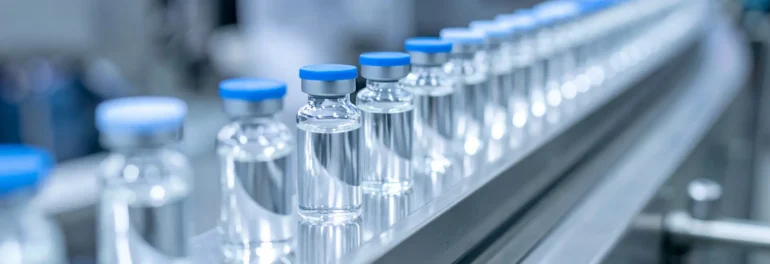
Sterile Vial Filling Line

Flexible Fill/Finish Solutions to Bridge the Clinical-to-Commercial Gap

The rapid evolution of the biopharmaceutical landscape, driven by personalized medicine, complex modalities, and orphan indications, is transforming the demands placed on sterile fill/finish manufacturing. At the same time, regulatory uncertainty, accelerated development timelines, and geopolitical volatility are reshaping how and where manufacturers produce therapies. In this high-stakes environment, drug developers need more than capacity — they need adaptable, strategic partners. Flexible, forward-thinking CDMOs that can scale, switch formats, and streamline tech transfer are uniquely positioned to help sponsors navigate uncertainty and reach the market faster.

Evolving Demands Require Flexible Fill/Finish Capacity

Over the past five years, the pharmaceutical landscape has undergone a dramatic transformation, particularly in the fill/finish manufacturing sector. The industry has weathered two major capacity crunches in rapid succession. The first, sparked by the global demand for COVID-19 vaccines and therapeutics, consumed nearly all available sterile filling capacity worldwide. Just as that demand began to subside, the market experienced another surge, this time driven by GLP-1 receptor agonists for weight loss and diabetes management. That wave culminated in the high-profile acquisition of Catalent’s fill/finish assets by Novo Nordisk, underscoring how acute demand pressures can reshape the outsourcing ecosystem. Today, GLP-1 products continue to dominate high-volume capacity needs, but they represent just one piece of a rapidly diversifying market.

Simultaneously, the rise of personalized medicines, orphan drugs, and complex biologics has shifted the industry’s center of gravity toward smaller, less predictable batch sizes. Many of these therapies target narrowly defined patient populations, use highly potent or temperature-sensitive formulations, and rely on formats that support infrequent dosing. Some have already gained regulatory approval, and many more are moving swiftly through the pipeline. The long-term commercial demand remains uncertain in most cases. Drug developers must therefore navigate accelerated development timelines and the challenge of making manufacturing decisions without clear forecasts.

Compounding the complexity is the growing use of expedited regulatory pathways, such as Breakthrough Therapy and Fast Track designations, which compress development cycles and intensify the pressure to establish robust chemistry, manufacturing, and controls (CMC) data early. For many programs in phase II and later, the bottleneck has moved from generating clinical data to how quickly and reliably teams can transfer, validate, and scale manufacturing for commercial launch. In this environment, drug developers expect contract development and manufacturing organizations (CDMOs) to enable not just rapid entry into first-in-human trials but also seamless progression from clinical to commercial supply, without compromising quality or compliance.

Meanwhile, sterile fill/finish operations face rising regulatory scrutiny. Recent updates to Annex 1 and other global guidelines have elevated expectations around contamination control and process validation. However, interpretations of what constitutes “best practice” vary widely across companies and regulatory agencies, especially between clinical and commercial phases. This regulatory ambiguity further underscores the need for flexibility in technology platforms and operational strategies as drug developers seek partners to support their products across an evolving regulatory and technical landscape.

Flexible by Design: What Tomorrow’s Fill/Finish Partners Must Deliver

As the pharmaceutical market continues to fragment — with demand fluctuating between high-volume blockbusters and small-batch, niche therapies — drug developers need fill/finish partners that truly understand their current and future needs and can evolve alongside their products. Drug developers need outsourcing providers that offer not just capacity but adaptive capacity: technical and operational flexibility that can accommodate shifting volumes, complex formats, and accelerated timelines across the clinical-to-commercial continuum.

To serve this new reality, CDMOs must excel in two distinct but interconnected forms of flexibility. The first is capacity flexibility, which refers to the ability to scale production up or down as demand evolves, whether due to changes in patient population, timing of regulatory approvals, or commercial uptake. The second is technical flexibility, which refers to the capability to handle a wide range of drug product presentations and formulation challenges. The needed flexibility includes sterile filling of vials, syringes, and cartridges in both small and large batches and expertise in handling diverse modalities, from highly potent compounds to lipid nanoparticles, and other complex formulations.

Equally important is the ability to support products as they transition through development phases. For example, a therapy may begin in a vial for early clinical trials but ultimately reach the market in a syringe or cartridge device. CDMOs must build the capability to manage these presentation shifts seamlessly, without compromising timelines or requiring redundant process development efforts. Supporting this flexibility may also involve stocking change parts, validating bracketed container closure systems, and working with multiple vendors to ensure uninterrupted supply.

True responsiveness requires a deliberate service strategy that strikes a balance between breadth and focus. The most effective CDMOs structure their offerings to meet a broad spectrum of client needs without introducing unnecessary operational complexity or supply chain strain. A CDMO can achieve these goals by curating a portfolio of filling technologies and capabilities that can flex as demand changes while maintaining a clear path for scale-up.

Forward-looking strategies also take the future into account. By designing facilities with modular layouts, unclaimed cleanroom space, and multi-format-ready infrastructure, CDMOs can rapidly expand in response to customer growth. This built-in headroom, guided in part by close collaboration with clients, positions them to support the needs of today’s drug candidates and the market leaders of tomorrow.

An Experienced Partner Poised for Growth

For over 20 years, Afton Scientific has established a reputation as a reliable and high-performing partner in sterile fill/finish. As a small, focused CDMO, Afton has prioritized technical excellence, regulatory rigor, and a customer-first approach. These values have earned the company a loyal client base and a strong record of repeat business.

Its ability to pair high-quality manufacturing with unusual agility has long set Afton apart. The company has consistently delivered flexible solutions across a variety of project types, dosage forms, and timelines while maintaining an exceptional track record with global regulatory authorities. That operational strength has made Afton a trusted partner for customers with diverse needs, from early-stage innovators to commercial-stage developers seeking a nimble alternative to large-scale providers.

Now, with market conditions calling for more adaptable and accessible fill/finish capacity, Afton is uniquely positioned to support customers on their product development journey. The company is making targeted strategic investments to significantly expand its capabilities and capacity without losing the responsiveness and collaborative spirit that have defined its model. This expansion is not a pivot but a scaling of what already works, designed to meet the growing demand from existing clients and new partners seeking a manufacturer that can combine technical breadth with a human touch.

Technical Versatility Meets Operational Readiness

At Afton Scientific, flexibility isn’t a buzzword; we build it into every layer of our operations. From container types to formulation processes, from batch sizes to analytical support, our infrastructure and expertise accommodate change. This flexibility enables us to support products throughout the entire development life cycle and respond quickly when project needs change.

Our filling lines accommodate a broad array of container formats, including vials, prefilled syringes, and cartridges, with the ability to manage transitions between them as a program advances through clinical phases and into commercial production. This flexibility is especially important for therapies that start in vials but ultimately transition to delivery via a device or alternate presentation. Afton can guide that transition, maintaining a unified process and minimizing the need for repeated validations.

Our manufacturing environment supports a wide range of drug products, including those with complex active pharmaceutical ingredients (APIs) and specialized formulation requirements. We routinely handle temperature- and light-sensitive materials, high-concentration or high-viscosity drugs, and DEA Schedule II controlled substances, each with its own technical and regulatory considerations. This flexibility enables us to support products throughout the entire development life cycle and respond quickly when project needs change.

To further enhance our adaptability, we’ve partnered with a network of qualified component vendors and proactively secured change parts for multiple vial, syringe, and cartridge sizes. This foresight allows us to rapidly onboard new presentations without the long lead times or logistical headaches that often follow container changes. It also ensures that we can offer clients options tailored to their delivery strategy, not just what happens to be pre-validated.

Our multiple filling lines span different technologies and production scales, enabling us to run small development batches or pivot quickly to accommodate larger-volume needs. In-house analytical and microbiology laboratories, staffed by senior scientists with decades of experience, strengthen that responsiveness. By developing and validating methods internally, we minimize dependence on external labs and reduce the risk of delays at critical handoffs.

Finally, our long-term expansion strategy is rooted in scalable flexibility. As we grow our facilities and equipment base, we are deliberately investing in technologies and layouts that will enable us to serve a broader range of products, customers, and market demands without sacrificing the agility that defines our approach.

Expansion Engineered for Flexibility

Afton Scientific’s expansion strategy is purpose-built to support the increasingly dynamic needs of the biopharmaceutical industry. Rather than simply adding capacity, Afton is investing in scalable, flexible infrastructure that empowers customers to grow, adapt, and accelerate their programs across development phases and product formats.

The expansion plan is two-fold: a near-term buildout with a state-of-the-art Flexfill production line to meet immediate demand and groundbreaking on a new facility designed for staged expansion. We engineered both assets with flexibility in mind, from cleanroom configurations to equipment specifications. Crucially, we designed the new facility with unclaimed modular space, which allows us to install additional filling lines quickly as needs arise. In line with evolving global inspection trends and the stricter sterility requirements of Annex I, we are installing top-of-the-line isolator filling lines and Annex I–compliant facilities to ensure we stay ahead of rising quality expectations. While we deliver the flexibility our clients need, we match it with the highest standards for sterility, contamination control, and facility design. This proactive “open capacity” model helps de-risk tech transfer timelines and ensures that scale-up doesn’t become a bottleneck as products mature.

In keeping with Afton’s customer-centric approach, existing clients will have input into designing and selecting new filling lines and technologies. This collaborative approach ensures that Afton aligns future capacity investments with real-world needs rather than speculative demand. Standardizing equipment across facilities also streamlines scale-up, tech transfer, and staff training, allowing Afton to preserve quality and efficiency even as it grows.

Recent investments reflect this forward-thinking strategy. The company is undergoing a threefold expansion of its in-house analytical laboratory, positioning it to support a broader array of assays, from early development through commercial validation. We are adding a new filling line utilizing ready-to-use (RTU) components to accommodate challenging configurations and accelerate project onboarding. Meanwhile, additional bulk lines are in development to support multiple presentation types — vials, syringes, and cartridges — on a single, flexible platform. Once validated, these lines will allow customers to pivot between formats as needed without redundant development cycles or lengthy requalification.

We are designing all of the new infrastructure to handle a diverse and simultaneous mix of products, with sufficient built-in capacity to support rapid onboarding and variable scheduling. The result is a future-proofed operation that balances growth with agility, an essential quality in a market where demand is as unpredictable as the science driving it.

Scaling Without Losing High-Touch Access

At Afton Scientific, flexibility is more than a manufacturing principle; it’s a cultural one. From day one, the company has built its reputation on technical capabilities and the strength of its relationships. A high-touch, customer-first approach is central to Afton’s operations, and this ethos starts at the top and extends across every team and function.

Maintaining that level of responsiveness and care is a top priority as Afton grows. While the company is investing in new facilities, technologies, and capacity, it is doing so with the clear understanding that scale must never come at the expense of service. The expansion strategy is deliberately paced, with milestones tied to real market demand and customer needs. That ensures not only operational sustainability but also cultural continuity.

Afton’s long-tenured, experienced staff is key to preserving this high-touch model, and our customers don’t just benefit from this experience behind the scenes. They work directly with our senior leadership team, gaining fast access to decision-makers who bring a “can-do” mindset and a proactive, problem-solving approach to every project. This close collaboration ensures clear communication, realistic timelines, and solutions tailored to each client’s unique needs.

Low turnover and a collaborative internal culture empower employees to take ownership of their projects, respond quickly to challenges, and build lasting relationships with clients. This continuity also enables the company to set realistic expectations, avoiding the industry pitfall of overpromising to win business, which often leads to missed deadlines and strained partnerships.

As scheduling pressures and portfolio complexity grow, Afton is investing in both people and systems to ensure that delivery timelines remain reliable, onboarding is seamless, and communication remains clear. Flexibility is valuable, but credibility is essential, and Afton is committed to earning both every step of the way.

The Future Belongs to the Adaptable

The biopharmaceutical industry is defined by constant evolution, and with that evolution comes a steady progression of new challenges. However, for agile, future-focused partners, those challenges are also the clearest opportunities for growth.

Increasingly complex modalities, from cell and gene therapies to RNA-based products, antibody–drug conjugates (ADCs), and high-potency small molecules, are becoming commonplace in today’s pipelines. These therapies often require non-standard presentations, unique formulation conditions, and smaller, more variable batch sizes. Simultaneously, the rise of personalized medicine and orphan drug development continues to drive fluctuation in production volumes and delivery formats, making predictability the exception rather than the rule.

In addition to these scientific shifts, drug developers must navigate a regulatory landscape that is becoming increasingly demanding and fragmented. Guidelines, such as EU Annex 1 and other regional frameworks, have raised the bar for sterile fill/finish operations; however, their implementation and interpretation vary across jurisdictions and product phases. Meanwhile, geopolitical uncertainties and supply chain vulnerabilities, exacerbated by recent global events, are prompting many companies to rethink how and where they manufacture critical therapies.

In this environment, success depends on working with outsourcing partners who can anticipate change, respond quickly, and grow alongside their customers. Afton Scientific believes that flexibility — delivered through innovative design, customer-centric processes, and experienced teams — is the key to converting complexity into opportunity.

Originally published on PharmasAlmanac.com on August 21, 2025.

A Gloved Hand Holding a Vial

Why Fill-Finish Strategy Can Make or Break Your Drug Program

With demand soaring and sterile capacity still limited, injectable drug developers can’t afford missteps in fill-finish strategy. Protecting sterility, securing the right capacity, and partnering early with a proven, adaptable CDMO can mean the difference between momentum and delay, and ultimately between approval and missed opportunity.

No Margin for Error: Sterility Assurance Starts with the Right Partner

Delivering an injectable drug means deliberately breaching the body’s first and most potent line of defense against pathogenic organisms without allowing those microbes to cross the barrier. For that reason, the quality of sterile fill-finish operations is non-negotiable. The core challenge is that one cannot confirm the sterility of a finished dose through testing without destroying it. Assurance must come from well-designed processes, rigorous environmental and procedural controls, and a highly trained team that understands exactly how to protect every unit produced.

Building an in-house aseptic manufacturing capability that meets these demands is enormously capital-intensive and demands a skilled workforce that is not readily available to many early-stage companies. For emerging biotechs preparing for their first-in-human trials, investing hundreds of millions to establish a validated sterile facility makes little sense. Selecting the right outsourcing partner is pivotal at this stage. A capable contract development and manufacturing organization (CDMO) doesn’t just provide the physical capacity to produce sterile injectables; it offers institutional knowledge, mature quality systems, and the ability to guide clients through the complex path to Investigational New Drug (IND) application approval and beyond. Without expert guidance, companies risk delays, costly missteps, and quality issues, even with a promising drug candidate.

Staying Ahead of Shifting Demand

Securing access to dependable sterile fill-finish capacity has never been more complicated or more critical. The COVID-19 pandemic starkly exposed the fragility of global capacity when demand surges overnight. Not long after, the explosive demand for GLP-1 receptor agonists for weight loss and diabetes further strained fill-finish capacity, with some major drug makers absorbing entire manufacturing lines for in-house use. These pressures forced smaller programs to scramble or risk costly delays.

Today’s pipelines add another layer of uncertainty. The steady growth of biologics, including monoclonal antibodies, antibody–drug conjugates, nuclear medicines, and multispecific antibodies, demands more complex handling requirements and increasingly specialized formats, ranging from IV bags to autoinjectors and on-body devices. Additionally, the delivery route, whether intravenous or subcutaneous, can shape how and where a product gets filled.

While many CDMOs and pharma companies are expanding capacity or breaking ground on new facilities, not all capacity is created equal. Much of what’s in the pipeline won’t be ready for at least two or three years, and some of it will come from generalist providers trying to add fill-finish alongside other services. However, sterile injectables require dedicated expertise and robust quality systems developed over decades, not capacity presented on a slide deck. A focused partner with deep, proven expertise in sterile fill-finish can serve as a critical safeguard when volatility makes predictions nearly impossible.

Plan Early, Scale Smarter

In the current volatile market, selecting the right fill-finish partner early on can significantly impact the success of a drug program. A CDMO with the right blend of experience, technical depth, and capacity to scale does not merely supply a service; it becomes a guide, helping emerging companies make critical decisions that have a ripple effect throughout clinical development and commercialization.

By involving an experienced CDMO during the earliest development phases, sponsors gain more than just filling capacity. They get access to insight on how to design robust manufacturing processes, validate analytical methods, and prepare for regulatory scrutiny down the road. Many smaller biotechs also benefit from advice on commercial realities beyond the plant floor, like understanding payer expectations and competitive positioning, long before launch. A strong partner helps close knowledge gaps that can otherwise stall progress or lead to missteps under pressure.

Working with the right partner early also minimizes one of the most significant hidden costs in drug development: tech transfer. Moving a program from one CDMO to another mid-stream drains time and budget, forces redundant process work, and increases the risk of supply disruption, all when the program should be building momentum toward approval.

To avoid these pitfalls, developers must carefully vet CDMOs. Look for proven sterility assurance, robust quality systems, and a history of delivering across multiple modalities and presentations. Equally important is flexible, right-sized capacity — enough to grow as a program succeeds, with realistic scheduling and contingency planning to absorb sudden shifts in demand.

Finally, developers should weigh whether to choose a one-stop-shop CDMO that offers multiple services or a specialist that focuses solely on sterile fill-finish. There’s no single correct answer: some programs require an integrated provider, while others benefit from the expertise of a dedicated fill-finish specialist who treats even small batches as mission-critical.

A Transactional Approach Doesn’t Cut It

Sterile fill-finish outsourcing fails when companies treat it like a simple transaction. True success requires a partnership founded on trust, transparency, and genuine engagement. The days when a CDMO could win business by just quoting capacity and locking in a slot are over.

Sponsors expect their manufacturing partners to invest time upfront to understand not just their technical needs but also their broader program goals. That means bringing real expertise to the table early and showing clear evidence that the CDMO can deliver on both capability and quality.

Once a project begins, communication should not stop at the project manager’s desk. Clients of all sizes want direct access to the scientists, engineers, and senior leadership who shape decisions and solve problems in real time. That level of access is what allows a program to adapt when things change, without every adjustment becoming an excuse for hidden costs.

Ultimately, a strong CDMO relationship is defined by more than the facility and equipment. It’s measured by whether the partner can stay responsive as requirements evolve, maintain cost transparency, and give sponsors the confidence that their product is truly a priority, not one of many jobs on a production schedule.

Supporting the Evolving Product Journey

Both customers and products undergo a journey as candidates progress from the clinic to commercialization. A drug’s presentation and delivery format rarely stay the same from first-in-human trials to commercial launch. In the early stages, speed to clinic often means using simple vial formats to get crucial dosing data. But as programs mature, the focus shifts to patient convenience, competitive advantage, and market realities.

To improve patient convenience, developers often shift monoclonal antibodies from intravenous infusion to subcutaneous injection as programs mature. A vaccine could move from multi-dose vials in the clinic to single-dose vials and finally to a prefilled syringe for ease of use at scale. These shifts can also mean new device choices, such as autoinjectors, on-body delivery systems, or multi-dose pens designed to fit patients’ daily lives.

Each decision point brings practical questions. What injection route makes sense? How viscous is the product? Will patients be able to tolerate the required needle gauge? What device spring force is needed? Perhaps filling in vials will provide the shortest time to the clinic, but the goal will be to switch to multi-dose pens for commercialization to address patient preferences. Even the secondary packaging design can matter for elderly or chronically ill patients who rely on easy handling.

Making these choices late can create costly bottlenecks. Switching from vials to pens, or from syringes to autoinjectors, often requires new process steps, new suppliers, and sometimes new manufacturing partners. However, when a fill-finish CDMO possesses the expertise, flexibility, and capacity to handle multiple formats and has the experience to manage transitions smoothly, sponsors can pivot within the same partnership. That keeps timelines intact and protects budgets from expensive, redundant tech transfers. Early collaboration with a partner ready to support every stage of this journey turns complexity into an advantage rather than an obstacle.

The Afton Advantage: Deep Focus, Real Flexibility

As a CDMO dedicated exclusively to sterile fill-finish, Afton Scientific combines deep technical experience with a personal, high-access service model that keeps quality at the forefront. Our leadership team brings more than a century of combined fill-finish expertise, and we’ve built an organization known for attracting, training, and retaining people who understand what it means to protect patients with every batch.

For Afton, strong partnerships are crucial to our operations. Every project, large or small, is treated as critical work. We prioritize smaller programs from emerging biotech firms because they form the core of our mission. We know these clients count on the kind of high-touch collaboration that only a focused, responsive partner can deliver, especially when navigating complex product lifecycles and tight timelines.

To stay ahead of our clients’ needs, we continually make strategic investments that enhance both our capacity and adaptability. By the end of 2025, our new Flex Line will come online, enabling the flexible filling of vials, prefilled syringes, and cartridges in batch sizes that scale with each program’s success. Our new facility will feature a larger version of this line, significantly expanding our capacity. Critically, these advanced lines generate rich, real-time process data that helps us identify and control risks before they reach the patient.

Beyond the fill lines themselves, we’re modernizing the entire operational backbone. Investments in new laboratory information management and manufacturing execution systems will replace paper-based processes with integrated digital workflows, enhancing accuracy, streamlining training and quality management, and strengthening regulatory compliance.

And because trust thrives on transparency, we’re installing secure digital cameras inside our filling rooms. With remote live viewing, clients can watch their product being filled from anywhere in the world, saving travel costs while strengthening oversight. At the heart of every decision is the same principle: a flexible, disciplined, and deeply engaged approach that enables our partners to deliver safe and effective therapies, regardless of market shifts.

Originally published on PharmasAlmanac.com on August 24, 2025.

Meeting the Changing Demands for Sterile-Fill Finish Operations

Optimized and error-free fill-finish operations in pharmaceutical and biopharmaceutical manufacturing are crucial to ensuring patient safety. The increasing complexity of small molecule APIs and the growing diversity of biologic drugs have both contributed to an increase in products targeted for parenteral delivery, which has expanded the demand for aseptic fill-finish operations. Meeting this growing demand for fill-finish services requires specialized expertise, appropriate equipment and innovations in both emerging technology and business models. 

Fill-Finish is a Crucial Step in Manufacturing

In pharmaceutical manufacturing, fill-finish operations are critical, since fill-finish is the last step before a product is packaged and ultimately delivered to the patient. By the time a drug reaches this stage, the drug product is highly valuable, as it has already been through labor- and cost-intensive production stages, including upstream processing, cell culture or fermentation and downstream purification. Failures in the integrity of the fill-finish stage can introduce microbial contamination and generate issues with formulation and dosing.1 The result could be loss of valuable product, production delays or even potential health risks to patients if the issues are not identified before the product reaches the market. Because of the potential risks to patients of contamination or drug product degradation that can be introduced at this critical manufacturing stage, as well as their highly technical nature, fill-finish operations are the subject of significant regulatory scrutiny.

Sterile Fill-Finish Operations Require Specialization

As a result, fill-finish requires specialized capabilities and equipment, as well as close coordination and interaction among personnel, equipment and facilities. Aseptic fill-finish operations bear more potential risks than non-sterile processes and as such require yet greater specialization and analysis. Aseptic fill-finish must be performed in a sterile environment, and all equipment and components must themselves be regularly sterilized. Expert oversight is necessary to ensure that the correct method be chosen (e.g., steam, dry heat, fumigants, radiation) to achieve sterilization without impacting the stability or pharmacokinetic properties of the drug product.2 Products that require lyophilization demand further sterile procedures to prevent the introduction of microcontamination during loading and unloading of the sterile dryer.

Additionally, lyophilization, or freeze drying, is often required in the production of stable formulations of sensitive parenteral drugs, particularly biologics. Creating appropriate aseptic conditions for lyophilization is an additional technical challenge for manufacturers, involving complex heat and mass transfer processes. Business consulting firm Roots Analysis predicts that the lyophilization market will grow at 9.5% annually from 2017 to 2027.3 In order to achieve lyophilization, both specialized equipment and expertise are required.

Growing Demand for Fill-Finish Services

Owing to the technical challenges and corresponding specialized expertise associated with aseptic fill-finish operations, pharmaceutical and biopharmaceutical companies are increasingly relying on contract development and manufacturing operations (CDMOs) to manage this crucial phase of production. Many companies do not possess adequate fill-finish operations for sterile products, but even companies with these capabilities use CDMOs as a backup source or switch from in-house operations at early development stages to an outsourcing partner for commercial manufacturing. In the 2017 Nice Insight CDMO survey of over 700 pharmaceutical industry professionals, the top reason given for engagement with CDMOs was “access to specialized technologies,” and 54% of respondents reported engaging outsourcing providers for clinical- and commercial-scale liquid dose form manufacturing services.4

Sterile fill-finish service providers are clearly responding to the increased demand for capacity and technical expertise, which in many cases exceeds available capacity. In the 12th Annual Report and Survey of Biopharmaceutical Manufacturing conducted by BioPlan Associates, eight out of ten respondents reported that they were planning to add at least one new technology to their fill-finish operations within the next two years. The majority of these respondents were employed by CDMOs.5 

Innovations Drive Changes in Fill-Finish Operations

Innovations in digitization, integrated IT, automation and environmental conditioning systems are driving this dynamic outsourcing segment. The broader shift in the pharmaceutical market from blockbuster drugs to specialized, targeted therapies intended for small patient populations is creating a need for fill-finish operations with flexible capabilities. These small-batch aseptic products not only create a new set of sterilization, handling and filling challenges, they require faster speeds to market.

The transition to flexible and multi-product fill-finish operations has been facilitated by advances in cleanroom technology, including isolators and restricted access barrier systems (RABS). Single-use technologies have been a driving force in fill-finish operation innovations, although it appears unlikely that single-use systems will ever entirely replace stainless steel equipment in these settings.6 Increased automation in fill-finish equipment and facilities is reducing many of the past sources of contamination risk. Wider industry trends, such as increased digitization, the push toward Industry 4.0 manufacturing models and serialization, are transforming both fill-finish operations themselves and the perception of the operations in broader development and manufacturing strategies. Fill-finish operations also need to remain flexible to keep up with changing, patient-centric demands for new drug-delivery systems that can better fit patient lifestyles and increase convenience and adherence.6 

Strategic Partnerships for Equipment Needs

For pharmaceutical companies maintaining their own in-house fill-finish operations for early development, clinical trials or commercialization and CDMOs providing those services to their customers, it is essential to make the best decisions when procuring equipment. The diverse considerations related to sterile fill-finish manufacturing ––from maintaining the sterility of the cleanroom and the equipment itself to assuring that the finished product is free of contamination without any degradation to the drug product itself –– make it especially critical to install the best and most appropriate equipment and to understand the capabilities and specifications of any equipment purchases from the planning stages. 

A strategic partnership with an equipment supplier like Federal Equipment Company –– with strong experience with a wide range of equipment manufacturers and with clients experienced in specialized services like sterile fill-finish –– is a crucial asset for any company looking to build or expand their fill-finish operations. Federal Equipment Company offers competitive prices on thousands of pieces of used pharmaceutical processing equipment from top equipment manufacturers. This includes aseptic fill-finish equipment, such as aseptic processing and filling machines, sterilizers and lyophilizers, for a range of packaging types (e.g. vials, ampoules, prefilled syringes), offering customers cost savings as well as reduced lead times for installation.

Federal Equipment Company offers additional relevant value-added services, such as operator training and equipment and bio-decontamination, to assist customers beyond just their equipment needs. Federal Equipment Company offers a validated three-step decontamination process that assures that equipment is free from β-lactam antibiotics and 99.9999% of potentially harmful pathogens and contaminates.

References

  1. Rader, Ronald A., Langer, Eric S.Fill-Finish Innovation. Contract Pharma. 13 Mar. 2013. Web. 
  2. Liu, Cindy, William Downey. “Biopharma Fill Finish Contract Manufacturing Market.” Contract Pharma. 20 Apr. 2017. Web.
  3. “Lyophilization Services for Biopharmaceuticals, 2017–2027.” Roots Analysis. 18 Apr. 2017. Web.
  4. CDMO — 2017 Nice Insight Contract Development and Manufacturing Survey.
  5. Langer, Eric S. “New Technologies for Fill-Finish.” Genetic Engineering & Biotechnology News6 (2016). Web.
  6. Jennifer Markarian. “Looking at Trends in Parenteral Manufacturing.” Equipment and Processing Report. 21 Jun 2017. Web.

Originally published on PharmasAlmanac.com on August 22, 2018

The Critical Role of Continuous Improvement in Parenteral Drug Manufacturing

In the competitive pharmaceutical manufacturing landscape, the ability to continuously achieve improvements in efficiency and productivity is essential to success. Given the higher complexity of parenteral drug manufacturing, continuously improving production processes is also paramount for ensuring the highest level of quality.

A Manual History

Just two decades ago, most production operations in parenteral drug manufacturing involved manual manipulation and intervention. Human operators were responsible for controlling all aspects of the production process, including the steps involved in producing the containers for final drug products, the preparation of drug product solutions, filling the containers with those solutions, and their final packaging before shipment. 

Many Opportunities for Improvement

Since that time, the pharmaceutical industry has undergone significant changes. Price pressures on generic drugs are tremendous today. At the same time, quality standards have continued to rise and are becoming more globally harmonized. Many generic manufacturers in emerging markets have been issued warning letters or had their facilities closed, and key drug imports produced by these firms have been halted in Western countries until compliance issues are addressed.

Manufacturing processes must be ultra-efficient while still maintaining the highest level of product quality and safety. Grifols has taken on this challenge with an ongoing continuous improvement program that includes everyone involved in the production of our parenteral and blood plasma products, from process design engineers to operators. We have focused on replacing inefficient manual operations that create opportunities for human error with highly automated, multifaceted processes that dramatically boost both quality and productivity.

This ongoing continuous improvement program has—and will—continue to enable Grifols to be a highly competitive and high-quality manufacturer of parenteral products with global approvals and recognition as a world-class pharmaceutical company.

Advantages of Automation

The automation of parenteral manufacturing processes using robotic systems enables tasks to be completed repeatedly in the same manner. Robots can be programmed to perform the same motion, exactly the same way every time, something that is not possible for humans to accomplish. Automation also reduces the level of human contact with the products, which, in turn, reduces the risk of contamination. Furthermore, reduced reliance on human activities minimizes opportunities for human error. Overall, automated processes are robust and efficient and lead to more consistent and higher-quality products.

Leveraging Technology to Streamline Operations

Grifols is currently manufacturing many of the same products that were produced 20 years ago, but in an entirely new manner and in an upgraded, state-of-the-art facility. The new parenteral manufacturing plant relies extensively on automated processes, from production of the plastic containers to the preparation of drug product solutions, to filling, sterilization, and final packaging.

Advances in technology have made the implementation of many of these automated solutions possible — one important example is form-fill-seal technology. Previously, Grifols produced plastic containers in a separate manufacturing area. Once the containers were manufactured, they were boxed and then placed in the warehouse until they were needed for the fill-finish step. At that point, the boxes were moved to the filling area, and the bags were removed and used for final product manufacture.

This double handling of the plastic containers was highly inefficient and included a significant time effort that did not add any value to the final product, but did increase its cost. Our solution was to adopt form–fill–seal technology for the production of plastic containers and to incorporate this process in the same line as the filling operation. Today, robots control the entire process, from the manufacture of the containers, which occurs immediately before filling, to final packaging.

As a result, we have eliminated all of the non-value-added movement of materials used in the process and the product itself, dramatically increasing efficiency and productivity. In addition, quality has been enhanced, because we also reduced the potential for contamination and risks associated with human error.

Overcoming the Challenge of Flexible Containers

One of the biggest challenges we face has been designing robotic systems that can handle the flexible plastic bags into which many of our products are filled. With premixed bags, the product is ready to use and requires no human intervention for reconstitution or dilution, increasing patient safety and caregiver convenience.

It is very challenging to design automated systems that can accurately manipulate flexible bags in a highly consistent and repeatable manner. For instance, temperature during the filling of the bags must be carefully controlled to avoid having them drop during handling. Working together, however, engineers and operators at Grifols have developed a system that is highly effective and reliable.

An Internal Engineering Team Makes a Big Difference

One of our key strengths at Grifols is our focus on controlling processes. The founder of the company, Dr. José Antonio Grifols Lucas, pursued an integrated approach to business and was continually inventing new tools and solutions. This same philosophy remains infused throughout all aspects of the company. Our employees enjoy working in our facilities and are passionate about improving how they work. They are always looking for novel approaches to our processes and developing new solutions.

This philosophy also led to the establishment of Grifols Engineering, a business within the Grifols Group that provides engineering services to the pharmaceutical industry. Having an internal engineering business is unique in the pharmaceutical industry. Most importantly, Grifols Engineering has been intimately involved in the design, construction and/or upgrading of Grifols’ facilities and various production lines.

The engineering team has extensive experience with process technologies employed across the company and brings this knowledge to each project. Engineering team members also collaborate closely with the production team to design process solutions that address their concerns down to the minutest details. The engineering group does not simply design and implement the process and hand it over to the production team — because the two groups work together, the operators also have ownership of the equipment and process and feel responsible for solving any problems that arise.

Attention to Details Pays Off

As part of our continuous improvement efforts at Grifols, we have learned that paying attention to even the smallest details can have a huge impact on the efficiency of facility operations. One example relates to the design of the trays used to support filled plastic bags when they are being sterilized in an autoclave.

To simplify the process, one of the goals for our new facility was to have one tray that could be used for all of the plastic bags we produce, regardless of their size and volume. In the process, bags are placed on trays and the trays are stacked one on top of the other. With the initial design, when smaller-volume bags were sterilized, a large amount of empty space existed between each of the stacked trays.

The engineering and production teams challenged themselves to develop a tray design that would still meet the goal of having just one type of tray yet provide different stacking options for bags of larger and smaller volumes. The solution was a tray that stacks differently when it is aligned with other trays in a parallel versus perpendicular orientation. One orientation leaves less space between the trays and is appropriate for small-volume bags, while the other results in a bigger gap between the trays to allow sterilization of large-volume bags. Paying attention to that little detail had a huge impact on productivity. The number of bags that could be sterilized was doubled.

Throughout the new Grifols facility, there are many other examples where collaboration between the engineering and production teams in addressing small issues has resulted in measurable improvements in performance.

Building on Experience is Valuable Too

Ongoing collaboration between the engineering and production groups also enables Grifols to build on its experience. For each new production unit that is installed, improvements are incorporated based on the lessons learned when operating existing equipment and systems.

As an example, on a filling line, operators followed instructions on a touch screen for the preparation of the product solution. To start, they selected this option to gain access to instructions for connecting the appropriate hoses. While this system provided some guidance to operators, it was still possible for them to connect the hoses incorrectly. This could lead to mistakes during the preparation of the solution.

For the new filling lines, the software has been upgraded, and additional controls have been implemented. Barcodes have been placed at each point where tubing can be connected, allowing the operators to confirm that they have attached the hoses correctly. In addition, the system will not allow the operator to proceed unless the tubing has been properly connected.

These types of improvements are routinely made at Grifols as a result of production personnel sharing their experiences and challenges with the engineering team. We are always looking for ways to learn from our mistakes, and the close collaboration among the operators and engineers makes it possible to develop increasingly effective solutions.

Results Tell the Story Best

The cumulative results of our continuous improvement efforts at Grifols are significant. Twenty years ago, in our older facility, production processes were based largely on manual operations. In our new state-of-the-art parenteral production plant, we have multiplied the number of units produced by 10. 

Due to the advanced automation and digital solutions that Grifols has implemented in the facility, we can track each individual product unit that is manufactured in the plant. For a batch of 45,000 units, at the end of the process in the packaging area, we can detect the loss of just one bag—something that was not possible two decades ago.

In addition to tremendous gains in efficiency and productivity, continuous improvement has resulted in enhanced and highly consistent product quality along with a significant increase in the confidence Grifols and our customers have in our processes.

Moving from Reactive to Proactive 

Continuous improvement is a never-ending process that becomes increasingly challenging as major inefficiencies and inconsistencies are eliminated. We strive to continue improving our processes at Grifols every day.

Perhaps most importantly, we are moving from a reactive mode to a proactive approach to continuous improvement. Rather than rely on errors and mistakes to identify opportunities for improvement, we conduct extensive risk analyses to determine areas where potential improvements are needed. In this manner, we are improving processes before any issues occur.

Current Challenge: Human and Robot Collaboration

At our new state-of-the-art facility, most of the processes are largely automated, from the manufacture of the bags to the preparation of product solutions, bag filling, sterilization, and final packaging. However, there are still processes that, due to their complexity, require manual intervention. 

At Grifols, we are working to develop a solution that will enable humans and robots to collaborate in the same area. Where appropriate, we will incorporate robots, but for some operations we will continue to rely on human operators. It is a very challenging mission and one that Grifols is tackling head-on as a component of our ongoing continuous improvement program.

Originally published on PharmasAlmanac.com on March 19, 2020